AhmedSix years old
Detained. Taken to a prison in Kabul, where he was renamed and told he would be killed if he ever used his own name again. A US-citizen child, held in a wartime prison for years before he was found and returned.
Case file "Prisoner 650"/ Held at FMC Carswell, Texas/ Status imprisoned — 86-year sentence
Neuroscientist. MIT graduate. Mother of three. Kidnapped in Karachi on March 30th 2003, disappeared for five years and tortured in US black sites, then sentenced to 86 years in a US courtroom that rested its verdict on a baseless case. She has been behind walls ever since.
Taken · 30 March 2003 · Karachi
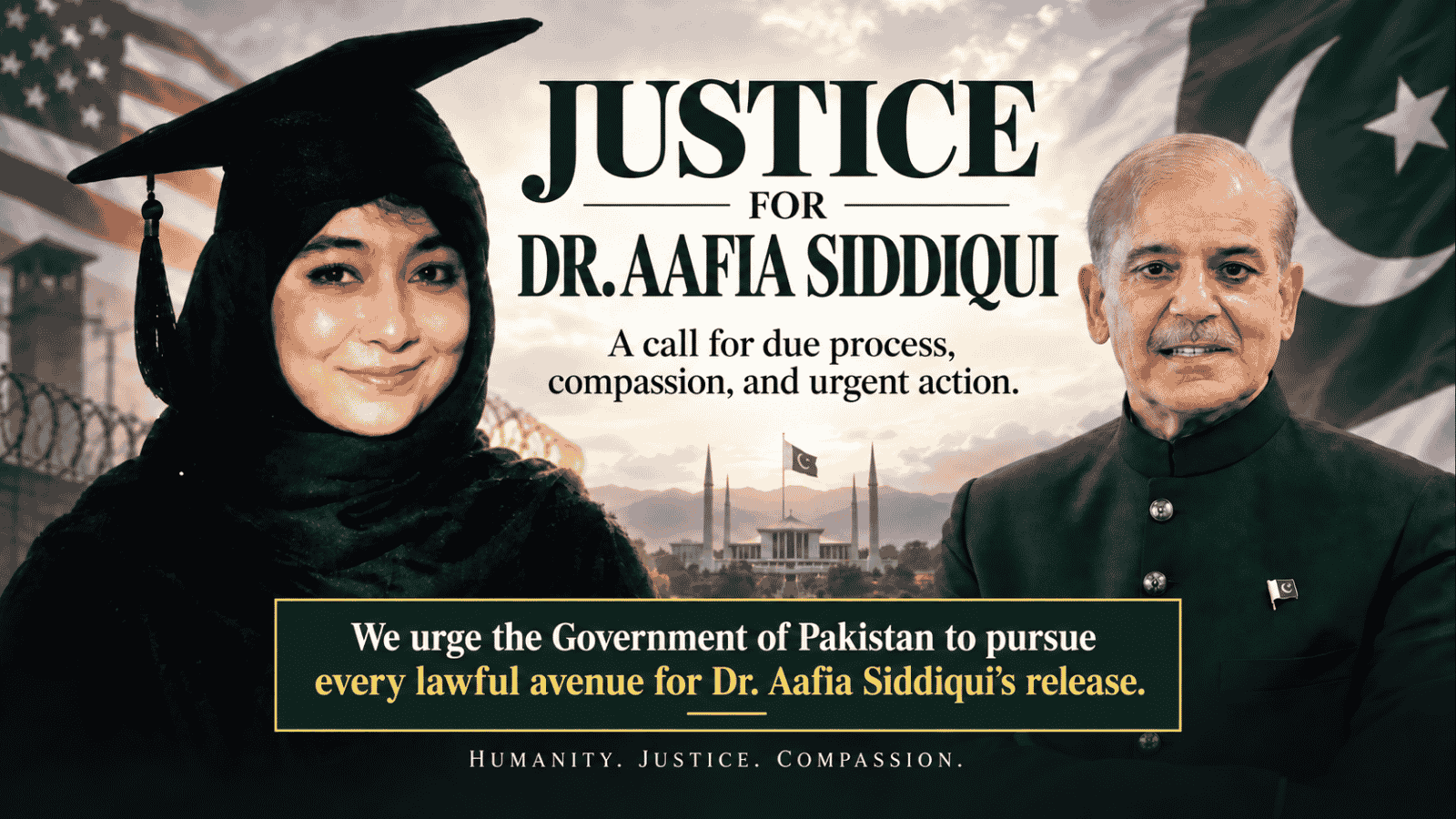
Aafia Siddiqui was born in Karachi on 2 March 1972, the daughter of a surgeon and a social worker. She came to the United States on a student visa at eighteen, won a scholarship to MIT, and graduated in 1995 — the same year she received the Carroll L. Wilson Prize for her research on Pakistan. In 2001 she earned her PhD in neuroscience from Brandeis University, studying how people learn through imitation. She dreamed of opening a preschool built on those ideas.
Her Boston years were lab, library, mosque and home. She volunteered with the elderly and neurodivergent children and raised funds for victims of war in Bosnia. Her sister is a Harvard-trained neurologist. By every account, hers was a life of study and service.
Then, in the climate after 9/11, everything changed. The FBI came asking about a credit card — equipment her husband had bought. Her name surfaced in interrogations of a man later confirmed to have made false statements under torture. A bounty was circulated. On 18 March 2003, the FBI issued an order to detain and question her. Twelve days later, she and her three children were gone.
2003 · 18 March
The FBI issues an order to detain and question Siddiqui. The United States government is by now offering a bounty for her — premised on statements extracted under torture-tainted interrogation, from a source who later said he made false confessions about himself and others.
2003 · 30 March
In Karachi, en route to the airport, Siddiqui and her three children are seized by a group of men. Her infant son, Suleiman, six months old, is killed during the abduction, according to her oldest son's account. Within the week, Pakistan's interior minister tells reporters she has been arrested; a ministry spokesman later confirms she was handed to the United States. Washington will spend five years denying it holds her at all.
2003 — 2008
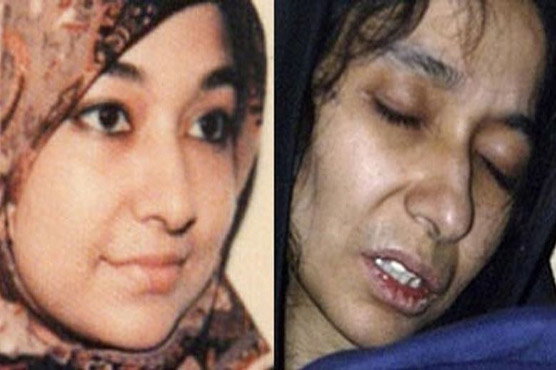
Held in secret at ████████████, identified by former detainees as "Prisoner 650" at Bagram Airbase, where male prisoners staged a days-long hunger strike over what they could hear happening to her. Amnesty International and Human Rights Watch add her to the list of suspected CIA ghost detainees. She describes tapes of her children's screams played for days, forced starvation, and sexual assault. The US ambassador to Pakistan insists she "was never in US custody."
2008 · 17–18 July
She reappears in Ghazni, Afghanistan, with her son Ahmed. Within a day, inside a police compound, she is shot in the abdomen by a US soldier. She is the only person wounded. The United States charges her — with attempting to kill Americans.
2008 — 2010
While recovering from the gunshot, she is tied to a hospital bed and interrogated for roughly eight hours a day — without being read her rights — in what she later described as "pure psychological, emotional torture." Court psychiatrists split over her competency. The press brands her "Lady Al-Qaeda" — in a case that contains no terrorism charge.
2010 · January — February
No fingerprints on the rifle. No gunpowder residue. No casings. The prosecution's nine witnesses contradict one another on how many people were in the room, where they stood, and how many shots were fired. Documents from her bag — handled by at least three people, left unattended in a truck — are admitted to show "motive." She is repeatedly ejected from her own trial for trying to speak about the secret prison.
2010 · 23 September
Convicted on all seven counts, she is sentenced to 86 years — with a "terrorism enhancement" applied to a conviction that contained no terrorism charge. Her response, in court: "I do not want any bloodshed… I really want to make peace and end the wars."
2018 · 15 November
Pakistan's Senate passes a resolution by unanimous consent calling for her repatriation. Presidents, prime ministers and foreign ministers of Pakistan have repeatedly appealed to Washington for her release. Nothing moves.
2021
At FMC Carswell she is assaulted by another inmate — scalding liquid thrown in her face — and is then placed in solitary confinement herself.
2024 · 19 September
Her lawyers file suit against FMC Carswell over years of alleged rape and sexual abuse by prison staff — the facility recorded the most staff sexual abuse of women in federal custody, 2012–2022 — and over the denial of religious visits: in more than sixteen years of custody, she has never once been permitted a visit from an imam.
Now
Her lawyers say significant new evidence deserves serious judicial review. With Pakistan's prime minister at the UN General Assembly in New York, every lawful legal and diplomatic avenue — release, compassionate transfer, repatriation, reunification with her family — can be pressed. That pressure begins with public voice. Yours.
Detained. Taken to a prison in Kabul, where he was renamed and told he would be killed if he ever used his own name again. A US-citizen child, held in a wartime prison for years before he was found and returned.
Disappeared into a war zone. Renamed Fatima and placed for seven years in the involuntary custody of a foreign family, until former President Karzai of Afghanistan helped bring her home to her own.
Killed during the abduction, according to his brother's account — dropped by the men who took his mother. His mother has never been told what became of him. She has spent more than two decades not knowing.
Two of these children were United States citizens. Their fates were reported by Clive Stafford Smith and Imam Omar Suleiman in Al Jazeera, November 2024. No one has ever been held accountable for any of it.
Under oath, asked whether she had picked up an M4 rifle and aimed it at anyone, she answered: "This is the biggest joke… Of course not." The defense showed there was no ballistic evidence the rifle had been fired at all — no bullets, no casings, no residue — and that the two bullet holes the soldiers pointed to were in the wall before 18 July.
She was ejected from the courtroom for trying to say why: "Since I'll never get a chance to speak… If you were in a secret prison, or your children were tortured…" The jury never heard the five missing years. The judge dismissed them as unproven. The only person shot that day in Ghazni — the person this case was supposedly about protecting — was her.
"There is no other woman who went through the full US Rendition to Torture program. There is no other case where a woman was abducted along with her three small children."
Clive Stafford Smith & Imam Omar Suleiman · Al Jazeera, 2024
Tape 01Centre Stage · Al Jazeera English
Tape 02Centre Stage · Al Jazeera English
Your first email goes to Pakistani diplomatic, legal and executive authorities ahead of the UN General Assembly, urging every lawful avenue for Dr. Siddiqui's release, compassionate transfer, and reunification with her family. Your second demands that journalists investigate the case and seek answers from the authorities. Both are drafted for you — you only need to send them.
Keep your message truthful, firm and dignified — that is what this campaign is, and abusive messages would only harm her.
Want to do more than send emails? Get involved with DFW Free Aafia Siddiqui — vigils near the prison, organizing in your own community, and ways to keep this case alive every week of the year.
The campaign that has kept Dr. Siddiqui's name alive in Pakistan for more than two decades — rallies, legal advocacy, and relentless pressure before parliament, press and public.
aafiamovement.com The case Aafia.orgHome of the international campaign — documentation of the legal record, news, and resources for everyone working for her release and repatriation.
aafia.orgThis email campaign is a start — not the finish line. DFW Free Aafia Siddiqui organizes year-round where she is held: vigils outside FMC Carswell, community education, and pressure that outlasts any news cycle. If you want to do more than send an email, start here — you don't have to be in Texas to show up.
Also on Instagram · @dfwfreeaafiasiddiqui
This page stands alongside these organisations and the families, lawyers, imams, journalists and former detainees who have carried this case. Add your voice to theirs — and when the emails are sent, keep going: join the organizing, show up, stay loud.
"I do not want any bloodshed. I really want to make peace and end the wars."
Dr. Aafia Siddiqui · at her sentencing, 23 September 2010
Send the email for her freedom →